

The ACS, the Republic of Colombia and the Republic of Korea inaugurate the Korea–ACS Joint Ocean Research Center
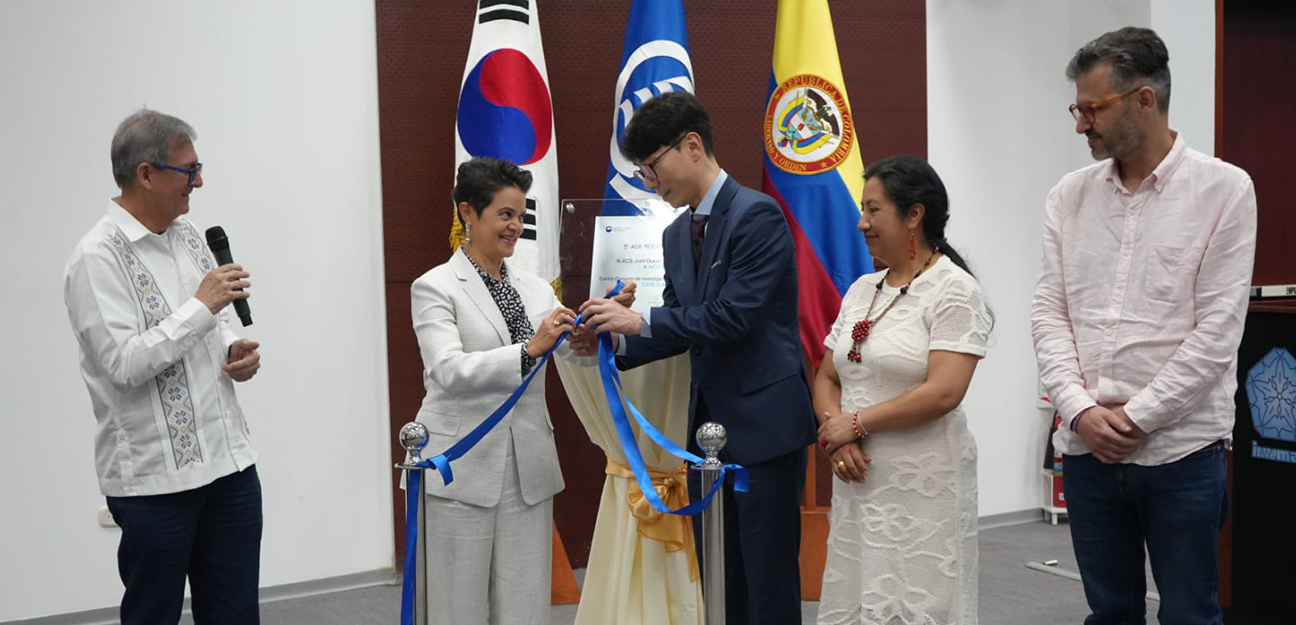
Santa Marta, Colombia, 20 May 2026 — The Association of Caribbean States (ACS), the Republic of Colombia and the Republic of Korea officially inaugurated the Korea–ACS Joint Ocean Research Center, a strategic milestone for strengthening scientific cooperation, climate resilience and ocean governance in the Greater Caribbean.
The Center will be housed at Colombia’s Institute for Marine and Coastal Research (INVEMAR) in Santa Marta, consolidating a regional space aimed at promoting applied ocean research, scientific innovation and technical cooperation for the benefit of the peoples of the Greater Caribbean.
During the opening ceremony, the Secretary-General of the ACS, H.E. Noemí Espinoza, emphasized that the Center represents “much more than the opening of a new scientific institution,” describing it as “a strategic decision for the Greater Caribbean.”
“The Caribbean Sea is not a border that separates territories. It is the space that unites destinies, societies and our shared future,” stated the Secretary-General, reaffirming the central role of the Caribbean Sea as a common heritage, a source of life and a strategic axis for the region’s sustainable development.
The inauguration of the Center reflects the strengthening of the partnership among the Republic of Korea — one of the ACS’s most active and committed Observers — the Republic of Colombia and the Association of Caribbean States, consolidating a regional platform to address shared challenges linked to the climate crisis, pressure on the oceans and the environmental, economic and social impacts affecting coastal communities across the Greater Caribbean.
In this context, the Secretary-General underscored that this initiative represents “practical multilateralism that produces concrete results,” highlighting that international cooperation must become a tangible tool for the development, resilience and stability of the region’s societies.
The Center will strengthen regional capacities to produce scientific knowledge, develop applied innovation and generate shared evidence to collectively respond to transboundary marine challenges, including coastal erosion, the degradation of marine ecosystems and the growing impact of sargassum.
It will also promote data interoperability, the strengthening of technical and scientific capacities, and the development of coordinated solutions for science-based ocean governance.
As part of the activities held in the framework of the Center’s opening, the Meeting of the Steering Committee of the Joint Ocean Research Center was held on 18 May. The meeting was chaired by Jimena Cuevas Portilla, Director of Disaster Risk Reduction, Sustainable Tourism, Caribbean Sea and Environment of the ACS, on behalf of the Secretariat of the Association.
During the meeting, the Steering Committee — composed of Francisco Arias Isaza, Director General of INVEMAR; Dahong Mun, representative of the Ministry of Oceans and Fisheries of the Republic of Korea; and Jimena Cuevas Portilla, representative of the ACS — held discussions aimed at approving key documents to guide the Center’s activities, including the Budget Execution Guidelines of the Korea–ACS Joint Ocean Research Center.
On 19 May, a symposium was also held to highlight the importance of international cooperation in the establishment of the Center and to identify priority areas for future research. The event featured 11 technical and scientific presentations, including Cuba’s intervention on behalf of the Chairmanship of the Caribbean Sea Commission, addressing the issue of beach erosion through the ACS Sandy Shores Project.
For its part, the ACS delivered the presentation “From Dialogue to Action: Regional Cooperation for the Protection of the Caribbean Sea,” in which it highlighted the importance of international cooperation for the establishment of the Center, its scope in strengthening regional governance and science-based decision-making, as well as regional progress promoted by the Caribbean Sea Commission to address sargassum.
In this context, the Association highlighted the establishment of the Sargassum Sub-Commission under the Caribbean Sea Commission as a regional coordination mechanism, and emphasized the initiative “Institutional Strengthening of the Greater Caribbean to Address Future Sargassum Influxes,” noting that scientific cooperation platforms such as the Korea–ACS Joint Ocean Research Center can contribute significantly to these efforts.
The ACS especially recognizes the leadership of the Government of the Republic of Colombia and the scientific and technical contribution of the Korea Institute of Ocean Science and Technology (KIOST), whose expertise in ocean research, artificial intelligence, satellite observation and data management represents a strategic contribution to the Greater Caribbean.
The Secretary-General further emphasized that INVEMAR “is not simply the host institution of this Center,” but an institution with an established track record in oceanography, marine biodiversity, coastal geology, climate and environmental information systems, providing a solid scientific foundation deeply connected to the realities of the Greater Caribbean.
This effort also strengthens the work promoted by the Caribbean Sea Commission and the vision of consolidating the Caribbean Sea as a Special Area in the Context of Sustainable Development within the United Nations system.
Likewise, the Center contributes scientific capacities, technical cooperation and applied knowledge that strengthen the vision of the ACS Futures Initiative (ACSFI2035), promoting regional initiatives focused on climate resilience, marine sustainability and innovation for development. In this way, ocean research is positioned as a strategic tool to translate cooperation into concrete results for the well-being of the Greater Caribbean.
The inauguration of the Korea–ACS Joint Ocean Research Center reaffirms the commitment of the ACS and its partners to a more resilient, integrated and sustainable region, where science, innovation and international cooperation are consolidated as fundamental pillars to protect the shared marine heritage and strengthen the voice of the Greater Caribbean in global ocean governance.


Share


Related News

From Regional Priorities to Investment Opportunities: ACS Advances Blue Economy Agenda in The Bahamas
Nassau, The Bahamas | October 2026 – The Association of Caribbean States (ACS) brought a regional perspective to the Diplomatic Week 2026 organised by the Government of The

ACS Secretary-General Highlights the Importance of Strengthening Regional Cooperation
Port of Spain, Trinidad and Tobago. October 2026 — In an interview with journalist Mylène Colmar, the Secretary-General of the Association of Caribbean States (ACS), H.E. Noemí
The ACS promotes a coordinated regional response to sargassum in Cancún
Cancún, Mexico. October 2026 – The Association of Caribbean States (ACS) carried out a working mission in Cancún to strengthen the regional response to sargassum, participating in
Greater Caribbean Agrees on a Common Position to Strengthen the Regional Response to Sargassum
Caracas, Venezuela. September 2026 — The members of the Sargassum Subcommission of the Caribbean Sea Commission of the Association of Caribbean States (ACS) agreed on a Common