


ACS Secures Strategic Commitments at Landmark 10th International Cooperation Conference During World Governments Summit 2026
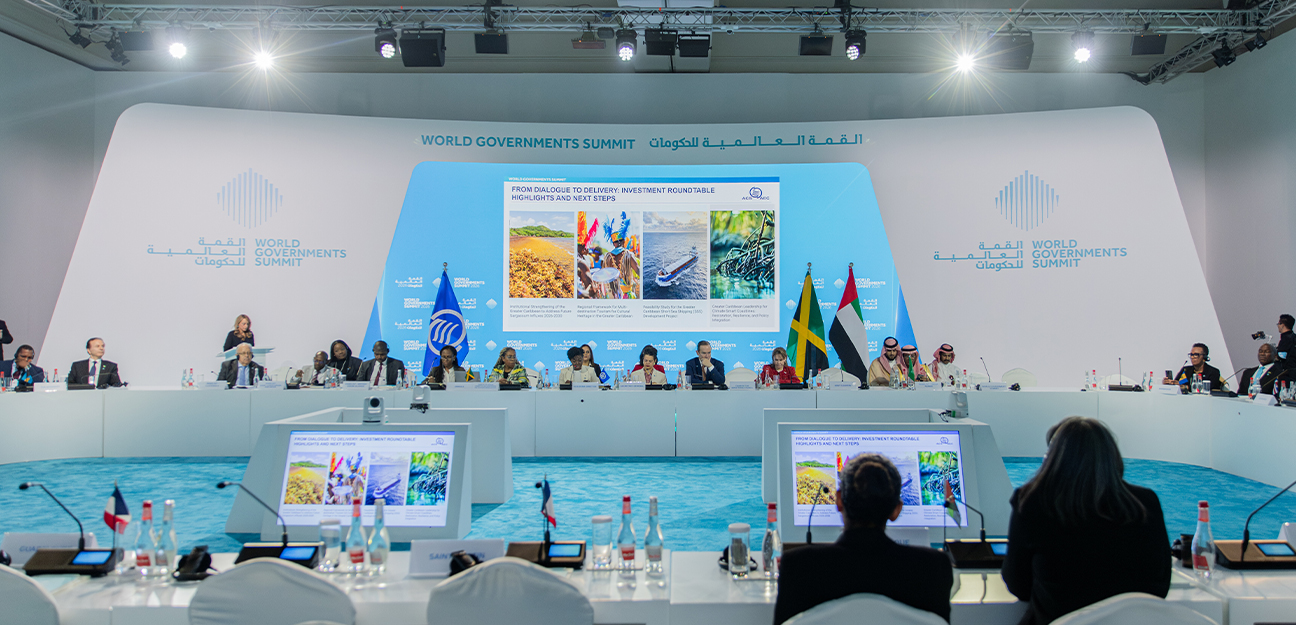
Dubai, United Arab Emirates | 6 February 2026 - The Association of Caribbean States (ACS) convened its 10th International Cooperation Conference (ICC) in Dubai, marking a strategic inflection point for delivery-driven regional cooperation and generating concrete progress on priority regional initiatives and advancing Caribbean–MENA cooperation to a new strategic level.
Held within the framework of the World Governments Summit 2026, this special edition marked a decisive shift from dialogue to implementation under the theme “Beyond 30 Years of Cooperation for the Greater Caribbean: Converting Cooperation into Concerted Action.”
“The decision to convene this 10th edition of the International Cooperation Conference within the framework of the World Governments Summit was a deliberate one. It required determination, sustained effort, and significant coordination. It was guided by a shared understanding that in the current global context, new ways of working and engaging are essential,” expressed ACS Secretary-General Noemí Espinoza Madrid.
The Conference was anchored in the ACS Futures Initiative (ACSFI2035)—the organization’s flagship framework to accelerate resilience, innovation, sustainability, and empowerment across the Greater Caribbean. Designed as a catalyst for collective action, ACSFI2035 mobilizes governments, communities, and partners around a shared vision: a resilient, inclusive, and sustainable region powered by its people, connected through modern systems, and anchored in the protection of the Caribbean Sea.
Bringing together 17 Member States and Associate Members, alongside six Partner and Observer States, the ICC replaced traditional speeches with focused Investment Roundtables—enabling direct technical engagement, country-level alignment, and clear next steps for implementation pathways under ACSFI2035.
“We want to move from declarative diplomacy to concrete and measurable action. The ICC must introduce a pragmatic approach to international cooperation, prioritizing implementation, real financial commitments, technical alliances, such as with the United Arab Emirates, and a clear roadmap,” stated the Chair of the ACS Ministerial Council, H.E. Javier Martínez-Acha Vásquez, Minister of Foreign Affairs of Panama.
Breakthroughs on ACSFI2035 Flagship Initiatives
The ICC advanced four flagship initiatives under ACSFI2035—each structured as a practical, investment-oriented pathway to strengthen regional resilience, deepen integration, and generate measurable benefits for people and economies across the Greater Caribbean. Together, these projects respond to shared priorities by improving environmental management, expanding sustainable tourism opportunities, modernizing maritime connectivity, and scaling nature-based solutions for coastal resilience.
Regional Sargassum Strategy (2026–2030)
Delegations advanced a coordinated regional approach to address escalating sargassum influxes through science, policy, and operational collaboration—strengthening preparedness and response capacity across the Greater Caribbean. Key objectives include leveraging the Regional Action Plan, establishing a regional monitoring network, and expanding knowledge transfer and technological solutions to support monitoring, containment, and valorisation. Expected results include improved access to regional data and early warning, stronger national technical capacity for forecasting and management, and enhanced science–policy collaboration.
Support for this initiative aligned with national priorities linked to coastal resilience, protection of fisheries and tourism livelihoods, public health preparedness, and climate adaptation—while reinforcing cooperation on shared marine risks.
Four Member States—Jamaica, the British Virgin Islands, Dominica, and Suriname—signalled interest as beneficiaries. Mexico expressed readiness to deploy technical expertise through its national institutions, while inputs from the Dominican Republic, Panama, Guatemala, and Martinique helped refine the project’s scope and operational design.
Regional Framework for Multi-Destination Tourism for Cultural Heritage
The ICC advanced a multi-destination framework to package and promote the Greater Caribbean’s cultural heritage experiences—particularly Carnivals and cultural offerings—positioning the region as a leader in this niche market. The framework seeks to deliver a cohesive regional brand and marketing approach, diversify tourism products, strengthen skills development, and promote responsible and regenerative tourism that is inclusive and culturally grounded. Expected results include increased visibility for Carnivals and cultural products, improved visitor experiences, and stronger community-based tourism participation—especially supporting women and youth groups.
Engagement reflected national agendas focused on tourism diversification, cultural industries, improved air connectivity, and community-based economic opportunities, while supporting a scalable regional model to strengthen competitiveness in global markets. Suriname, Saint Lucia, and Guatemala were identified among potential beneficiaries.
Greater Caribbean Short Sea Shipping Feasibility Study
Delegations explored a strategic connectivity initiative to assess the feasibility of establishing Short Sea Shipping routes among regional ports—supporting lower logistics costs, stronger access to international supply chains, environmental sustainability, and expanded public–private partnerships. The project includes establishing a Regional Maritime and Trade Data Observatory, delivering a feasibility study to define viability and priority corridors, analyzing intraregional trade flows and logistics chains, assessing port infrastructure readiness, and supporting a regional maritime and port policy framework for sustainable operations.
Discussions aligned with shared priorities around trade competitiveness, transport modernization, emissions reductions, and more reliable intraregional supply chains—reinforcing national efforts to strengthen ports, logistics services, and regional integration. Jamaica emerged as the champion country to advance the feasibility phase, with Saint Lucia expressing interest as a beneficiary. Panama’s global connectivity model and the Dominican Republic’s maritime transport experience were highlighted as strategic reference points.
Climate Smart Coastlines Initiative
Participants were introduced to an ACSFI2035 flagship initiative to strengthen climate resilience through restoration of mangrove and seagrass ecosystems, combining science-based restoration with improved governance and innovative financing to reduce climate and disaster risks. Objectives include restoring and protecting critical coastal ecosystems, integrating blue carbon ecosystems into national climate and biodiversity frameworks, enabling community participation in coastal management and sustainable livelihoods, and positioning the Greater Caribbean as a global reference for climate-smart coastlines.
This initiative aligns with national priorities related to coastal protection, biodiversity, blue economy development, climate finance readiness, and community-centered resilience, while reinforcing regional leadership on ecosystem-based adaptation.
A Strategic Bridge Between Regions
For the first time convened in Dubai, the ICC leveraged the combined partnership of the ACS, the United Arab Emirates, and the World Governments Summit to place the Greater Caribbean on a global platform —not as a beneficiary region, but as a proactive partner shaping its own development trajectory— expanding cooperation pathways and strengthening practical collaboration between the Caribbean and the MENA region.
With the Investment Roundtables completed and country interest clearly identified, the ACS Secretariat will advance technical refinement, resource mobilization, and structured follow-up—working alongside partners to translate the Dubai outcomes into funded, implementation-ready initiatives under the ACSFI2035 portfolio.
The message from the 10th ICC is clear: through ACSFI2035, the Greater Caribbean is institutionalizing a new architecture for results-oriented regional cooperation—embedding implementation, investment alignment, and measurable impact at the core of its collective future.


Share


